

March 9, 2026
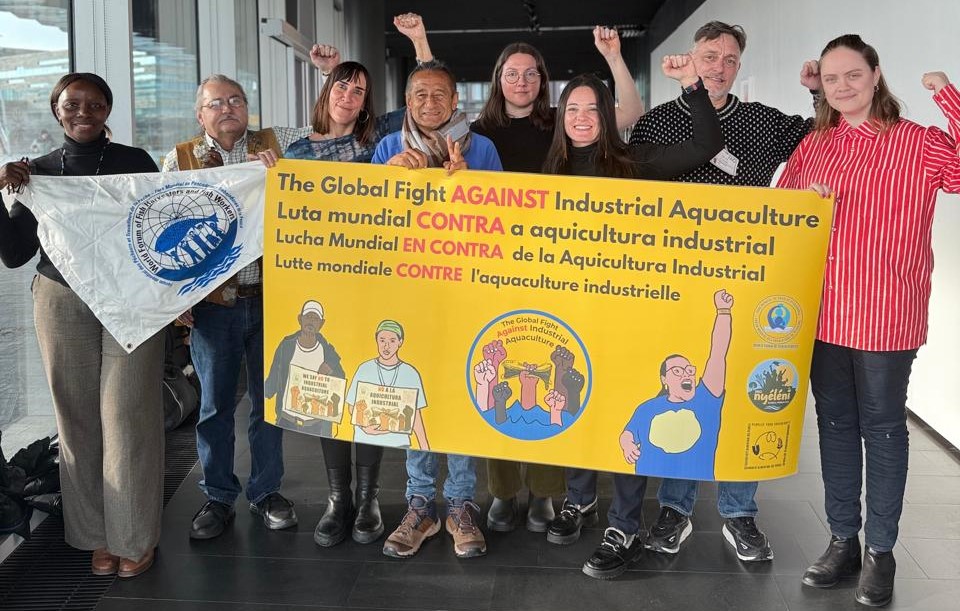
The International Planning Committee (IPC) Working Group on Fisheries participated in the Second Session of the Sub-Committee on Fisheries Management (COFI:FM) of the Food and Agriculture Organization of the United Nations (FAO) in Reykjavík, Iceland. A small IPC Working Group on Fisheries’ delegation formed by Chief Gary (IITC), Margaret Nakato (WFF) and Lider Gongora (WFFP), actively engaged to ensure that the voices of small-scale fishers, fish workers, collectors and Indigenous Peoples were listened in global fisheries management discussions. Through our participation, we reiterated our willingness to engage in political dialogue and to jointly build public policies that recognize the central role of the peoples of mangroves, seas, rivers, inland waters, and oceans.
The second session of the COFI:FM focuses on fisheries management policies, with a focus on conservation and sustainable use of fish stocks, multispecies management, fleet capacity, regional fisheries governance, and the social dimension of fisheries. For us, effective fisheries management cannot exist without securing the customary tenure rights, recognizing traditional and Indigenous People’s knowledge systems, and promoting informed and effective participation of fishers in fisheries management.
Throughout the plenary discussions, we underlined the intrinsic connection that the peoples of the mangroves, the sea, and all waters have spiritually, culturally, and economically with their territories and natural resources. In many countries, small-scale fishers and Indigenous Peoples face dispossession, water and land grabbing. These are caused by industrial aquaculture expansion, oil and gas, exclusionary conservation, large-scale tourism and Blue Economy. Restoring and recognizing customary and collective tenure rights is the only way for sustainable governance and small-scale fisheries management.
We called for ensuring formal recognition of small-scale fishers, fish workers, collectors, Indigenous Peoples, and especially women, whose labour remains largely invisible, as rights-holders and as fundamental political actors. Effective and meaningful participation must replace token consultation. Fisheries governance must move toward the formal integration of grassroots organisations – such as cooperatives, local committees and women’s associations – into regulatory frameworks and decision-making processes.
Fisher peoples are environmental stewards, custodians of inland and coastal waters and adjacent land, with diverse traditional knowledge, experience and good practices that have allowed them to feed their communities, sustain healthy fish stocks, care for local biodiversity and maintain livelihoods for generations.
The IPC Working Group in Fisheries highlighted that in 2014, governments made a commitment to small-scale fisheries by endorsing the FAO The Voluntary Guidelines for Securing Sustainable Small-Scale Fisheries in the Context of Food Security and Poverty Eradication (SSF Guidelines). Their implementation is key for our lives and livelihoods, and to ensure the right to food and access to resources.
In alignment with the deliberations of the COFI Sub-Committee on Fisheries Management (COFI:FM) in 2024, which reiterated the urgent need for FAO to support the SSF Guidelines’ implementation, the IPC Working Group on Fisheries called upon all Member States to reaffirm their commitment to the Global Strategic Framework in support of the implementation of the SSF Guidelines (SSF-GSF) as a mechanism to collaborate at global level to advance the implementation of the SSF Guidelines and secure the inclusion of small-scale fishers and Indigenous Peoples in policy dialogues.
Small-scale fishers, harvesters, collectors, processors, Indigenous Peoples, including women and youth, are not merely stakeholders in fisheries governance – they are rights-holders and custodians of living waters. We will continue to resist and fight for Food Sovereignty to build just societies and sustainable and resilient food systems worldwide.