

March 9, 2026
Twenty years ago, between the 7th and 10th of March 2006, the International Conference on Agrarian Reform and Rural Development (ICARRD) was held in Porto Alegre, Brazil. The landmark conference brought together States from across the globe alongside social movements and civil society actors representing peasants, Indigenous Peoples, and other such communities, to underscore the importance of redistributive agrarian reforms and equitable access to natural resources, approached both through a collective and human rights-based policy lens. [1]
Right before the Conference, between March 6th and 9th, 2006, the International Planning Committee for Food Sovereignty (IPC), formerly known as the International NGO/CSO Planning Committee for Food Sovereignty, the main facilitator for the participation of social movements and civil society organisations at ICARRD, organised the “Land, Territory and Dignity” Forum, an independent and autonomous space designed to allow social movements to come together to debate, articulate their positions, and develop proposals that would feed into the Conference. [2]
The Forum aimed at amplifying the struggles of social movements for land, water, seeds, fishing grounds, forests, and agroecological rural development, presenting food sovereignty-based proposals on agrarian reform, exposing repression and violence within rural spaces while advancing strategies of resistance against the criminalisation of rural struggles, and challenging the prevailing development model. [3]
The years that followed brought victories. The United Nations Declaration on the Rights of Indigenous Peoples (UNDRIP), Voluntary Guidelines on the Responsible Governance of Tenure (VGGT), and the United Nations Declaration on the Rights of Peasants (UNDROP) were built on the foundations of the Conference of Porto Alegre. [4]
Despite these achievements, persistent challenges remain. Two decades after ICARRD, land continues to be a critical issue. Extreme concentration of land ownership, insecure tenure, and large-scale land grabbing by extractive and agro-industrial interests continue to drive rural poverty, fuel hunger for over 730 million people, and displace communities, while the compounding pressures of climate change, gender discrimination, and youth exclusion further threaten the livelihoods and futures of small producers and rural communities worldwide. [5]
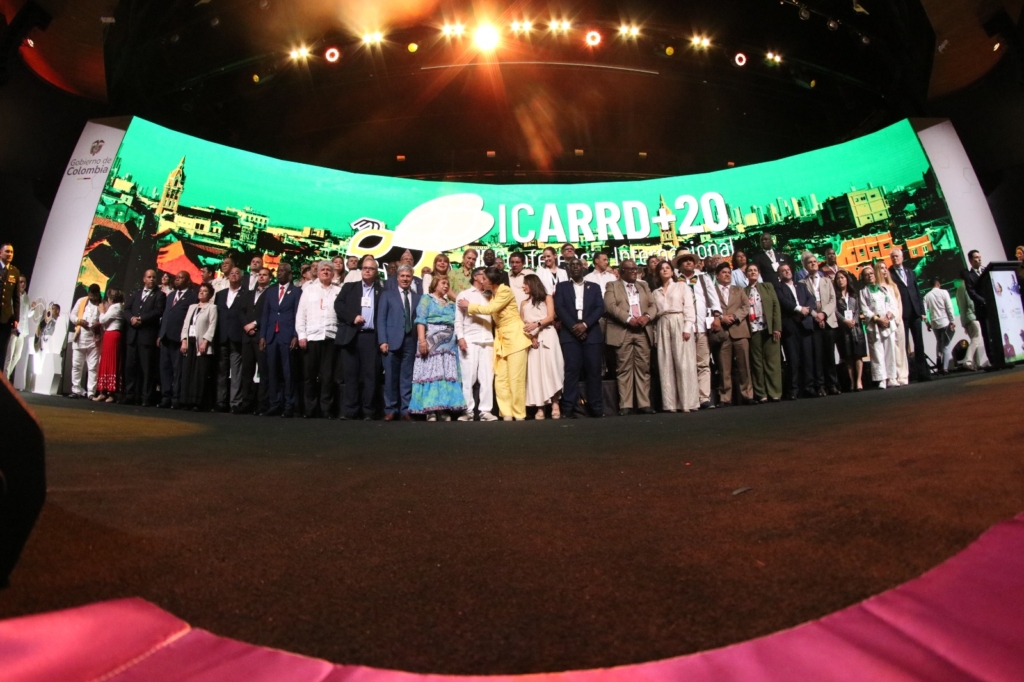
And so, once again, the Working Group on Land, Forests, Water and Territories (Working Group) of the IPC, organised a preparatory space from the 22nd and 23rd of February, 2026 called the “Forum of Peoples and Social Movements: United for Land, Water, Territories, and Dignity,” to collate concrete proposals ahead of the Second International Conference on Agrarian Reform and Rural Development (ICARRD+20) held in Cartagena, Colombia between the 24th and 28th of February, 2026.
ICARRD+20 seeks to comprehensively assess global land tenure systems, evaluate the implementation and effectiveness of key international human rights instruments, and advance agrarian reform and rural development through fair, resilient, and sustainable agri-food systems. By promoting international cooperation, especially for social and climate justice, the Conference aims to ensure that rural communities are recognised as custodians of land, territories, and ecosystems. [6] Simultaneously, the IPC has also outlined its vision, calling for agrarian reform grounded in four pillars: recognition of Indigenous Peoples’ and customary rights over land, territories, and water; redistribution of land and natural commons, including limits on corporate and military accumulation; restitution for communities dispossessed by land grabbing, colonialism, occupation, and conflict; and strong regulation of land markets to protect food-producing territories from extractive industries, land speculation, and military appropriation. [7]
***
The Forum of Peoples and Social Movements opened with agenda-setting statements from the Working Group coordinators.
Saul Vicente, from the International Indian Treaty Council (IITC), dismayed twenty years down the line from ICARRD, social movements are continuing to demand “land, territory and dignity,” despite gains such as the VGGT, UNDRIP and UNDROP. He urged that land and territorial rights be placed at the centre of global responses to climate, food and social crises, affirming movements’ readiness to offer solutions or defend the commons through the People’s Forum at ICARRD+20.
Nuri Martínez of La Via Campesina (LVC) welcomed the decision to hold the ICARRD+20 in Colombia, acknowledging the government’s political commitment to agrarian reform and its constitutional recognition of the peasantry as rights-holders. She identified a common enemy in imperialism and the extractive economic model threatening both rural communities and progressive governments across the region, calling for strong coordination and a bold declaration from social movements to sustain and advance the struggle.
A roundtable discussion on how ICARRD+20 can contribute to promoting the right to territories followed the welcome statements.
Martha Carvajalino, Minister of Agriculture and Rural Development, opened by reaffirming the Colombian government’s commitment to agrarian reform and its solidarity with those fighting violence and injustice, including the people of Gaza, the peasantry, and Indigenous Peoples. The Minister of Environment, Irene Vélez Torres identified three traps blocking rural communities from their rights: the criminalisation of farmers, dispossession disguised as conservation, and the exclusion of people from their territories in the name of nature, recommending participatory zoning and the recognition of Indigenous authorities as environmental authorities as part of broader efforts to reconcile environmental protection with the rights of communities that steward the land.
Speakers from the social movement spectrum across the globe brought distinct but interconnected perspectives, converging on a shared diagnosis: that current governance and economic structures have deepened the precariousness of the very communities who steward our lands and waters.
Musa Sowe of Réseau des Organisations Paysannes et de Producteurs de l’Afrique de l’Ouest (ROPPA) stressed that small-scale farmers, who produce the majority of the world’s food, must be guaranteed inclusive and equal participation in agrarian reform processes, free from the influence of institutions like the International Monetary Fund (IMF) and World Bank, and have access to territorial markets and sovereignty over their land, seeds, and food systems. Daniela Crabali from Proceso de Comunidades Negras (PCN) emphasised that for Black communities, territory is inseparable from culture, identity, and life itself, calling for agrarian reform grounded in an anti-racist, protective, restorative, and reparative framework. Khalid Khawaldeh from World Alliance of Mobile Indigenous Peoples and Pastoralists (WAMIP) noted that while ICARRD was a pivotal moment, its agreements largely overlooked pastoralists, and called on ICARRD+20 to recognise their rights to mobility, collective land use, and participation in policymaking, stressing that pastoral systems are among the most efficient and sustainable forms of livestock production.
Melanie Brown of the World Forum of Fisher Peoples (WFFP) warned that aquaculture and the Blue Economy are dispossessing fishing communities and destroying wild fish stocks, calling for greater recognition of small-scale fishers’ contributions to food systems. Rodrigo Niño from Coordinación Nacional de Pueblos Indígenas (CONPI) stressed that agrarian reform must be reviewed within the context of centuries of Indigenous dispossession, emphasising access to land and natural resources alongside social structures like education and stronger urban-rural dialogue. Yurani Pérez of the Asociación Campesina del Valle del río Cimitarra (ACVC) recognised that social organisation is the foundation of meaningful agrarian reform, calling on the government to listen to peasants and women and invest in peasant economies and education.
Following the roundtable discussion were two rounds of plenary-like sessions called Content Blocks.
The first Content Block examined the situation of communities with regard to rights over their territories, the threats driving dispossession, and the strategies being built to combat them, bringing together perspectives from across the social movement spectrum.
Hatem Aouini of LVC highlighted the struggle for agrarian reform within a global context of rising fascism, imperialism, and extractivism, pointing to Palestine, Sudan, and Congo, while affirming that movements have won victories in India and Latin America and have a concrete proposal in the IPC’s four pillars for popular agrarian reform. Fernando Garcia Dory of WAMIP called for recognition of collective pastoral rights, pointing to governance models in Chad and Kyrgyzstan as examples, while warning of threats from mining, renewable energy, and industrial livestock interests encroaching on communal lands.
Virginie Lagarde of the WFFP warned of accelerating blue and green grabbing threatening artisanal fishing communities, calling for binding commitments and genuine community control over marine and coastal territories. Dmitry Berezhkov from the International Committee of Indigenous Peoples of Russia (ICIPR) pointed to the inseparability of Indigenous territorial rights from food sovereignty and climate justice, warning of green extractivism and rising authoritarianism, while drawing attention to the arrest of Selkup Indigenous leader Daria Egereva in Russia as illustrative of the global criminalisation of land defenders.
Elga Betty from the Confederation of Family Producer Organizations of Expanded Mercosur (COPROFAM) evoked historic agrarian reforms, including revolutions in Mexico in 1910, Bolivia in 1950, Cuba in 1959, Chile in 1962, and Peru in 1969. She alleged communities were still grappling with the consequences of the COVID pandemic and called for agroecology, native seed protection, and implementation of the UNDROP and the Indigenous and Tribal Peoples Convention, 1989, as the path forward. Sophie Nglapi from the World March of Women (WMW) exposed the stark contradiction that women produce between 60 and 80% of the world’s food yet own less than 15% of arable land, calling for a feminist economy and land sovereignty.
Carlos Bona of Mouvement International de la Jeunesse Agricole et Rurale Catholique (MIJARC) warned that without generational transfer of land and self-determination, young people’s access to and their rural identity are limited. Mohammed Abdel Rahman Salem of Habitat International Coalition (HIC) spoke from the frontlines of Palestinian dispossession, pushing back against the neoliberal framing of land as a commodity and affirming that resistance is expressed through planting olive trees, rebuilding homes, and organising for food sovereignty.
Drazen Simlesa of Réseau Intercontinental de Promotion de l’Économie Sociale Solidaire (RIPESS) promoted solidarity markets, short supply chains, and community care systems as expressions of a social and solidarity economy, asserting that without territory there is no food sovereignty and without food sovereignty there is no dignity. Isa Alvarez of URGENCI challenged the producer-consumer dichotomy, calling for food-consciousness and agroecological transitions from the consumption end, while warning against the normalisation of toxic food systems. Graciela Ines from People’s Health Movement (PHM) argued that human health is inseparable from the health of territories and ecosystems, and that land concentration and green grabbing are driving malnutrition and poverty, calling for agrarian reform and food sovereignty as essential conditions for healthy and sovereign communities.
The first day of the Forum closed with the second Content Block that put the ICARRD+20 and the IPC vision in context.
It opened with Morgan Ody of LVC, who traced the origins of the first ICARRD to the 1990s wave of neoliberal land privatisation driven by the World Bank and World Trade Organisation, framing it as a deliberate pushback that ultimately delivered key victories for the VGGT, UNDRIP, and UNDROP. She noted that new forms of land grabbing have since emerged through digitalisation, carbon credits, and biodiversity offsets, and recounted the tribulations through which the idea of ICARRD+20 was revived after COVID and eventually secured through Colombia’s intervention at the Committee on World Food Security. She expressed her disappointment with the lack of support for ICARRD+20 from the Food and Agriculture Organisation and applauded the strong commitment shown by the governments of Colombia and Brazil.
Tammi Jonas of Agroecology and Food Sovereignty Alliance (AFSA) presented the IPC’s position paper, developed through a broad consultative process across member organisations, covering the history of land grabbing, the current context, and concrete proposals including land taxation, redistribution, reparations, and restitution, with a declaration drafting committee working to distil its key points into a forum declaration.
***
The second day of the Forum, critical discussions resumed.
The third and last Content Block, discussed agrarian reform and food sovereignty through a regional lens, with delegates splitting into distinct groups from the Americas, Africa, Asia and the Pacific, the Middle East and North Africa (MENA), and Europe and Central Asia to discuss the main challenges facing agrarian reform in their regions, the relevance of the IPC’s updated vision, their expectations of ICARRD+20, and draft actions movements would take upon returning home to advance agrarian reform.
Guiding remarks were offered by Philip Seufert of FIAN, who also incidentally leads the Working Group, with the block being facilitated by Saphia Ngalapi of WMW and Benjamin Mutambukah of WAMIP. The regional working groups all came back demanding urgent agrarian reform and accountable commitments that place the right to territory back in the hands of the people.
The African regional working group lead by Chengeto Muzira of LVC, presented a grievous image of a continent made vulnerable by land grabbing by state and private actors, weak legal frameworks, political instability, climate change, corporate expansion, and the promotion of GMOs compounding an already fragile situation. Recognition was identified as the most pressing priority, particularly the securing of customary, pastoral, collective, and women’s land rights, followed by regulation to combat land grabbing, and redistribution and restitution to correct deep historical inequalities. The group hoped ICARRD+20 results in a decisive shift from policy dialogue to implementation, backed by monitoring and evaluation mechanisms, institutional strengthening of civil society, increased public investment, and the genuine participation of women and youth in policy design. On returning home, participants committed to building common positions with peasant networks, engaging governments directly to place agrarian reform on national political agendas, promoting agroecology and territorial markets, and establishing regional monitoring platforms to hold governments to account.
The Americas working group lead by Melanie Brown of the WFFP and Taily Terena of the IITC offered a succinct statement. With territory understood not merely as land but as the very space of political struggle and dignified life, the group framed agrarian reform as inseparable from the recognition of historical dispossession, colonial legacies, and patriarchal systems. Their proposals centred on free and prior informed consent, the protection of peasant and Indigenous peoples, and the elimination of external debt that is used as a tool of imperial domination, while calling for public agrarian policies, massive land recovery, and the inclusion of solidarity economies within agrarian reform frameworks, united by a vision of popular power built across the Global South and North.
The Asia Pacific group, facilitated by Asma Aamir of the WMW, highlighted a region rife with interconnected crises, from land and ocean grabbing, conflict, occupation, war, and militarisation, to climate breakdown and biodiversity loss, digitalisation as a new frontier of control, and structural inequalities deepened by State complicity and austerity measures driven by debt through institutions like the IMF and World Bank. The group stressed the recognition and self-determination of agrarian communities and Indigenous Peoples, redistribution through comprehensive agrarian reform that avoids corporate capture, restitution for communities displaced by climate change, and regulation through concrete national legal reforms. They also proposed three additional Rs beyond the IPC’s four pillars: representation, resources, and revolution. Looking ahead, the group called for local movement unification and intersectionality, stronger linkages between ICARRD+20 and UN body processes, including special rapporteur visits to report on progress, and FAO reform as a precondition for implementation, without which the conference’s commitments risk remaining paper tigers.
Souad Mahmoud of Coordination Féministe pour la Souveraineté Alimentaire (CFSA) along with Khalid Khawaldeh of WAMIP lead the MENA working group who stressed that agrarian reform cannot be discussed in isolation from the colonial realities of the region, including the ongoing crises in Palestine, Syria, and Lebanon. Furthermore, the situation was compounded by gender disparity, patriarchy and an absence of political will to pursue structural reform. The group emphasised that at this juncture, reparation was more appropriate that restitution, while calling for stronger enforcements of mechanisms established since 2006, and moving away from top-down solutions toward grassroots training and network strengthening.
The Europe and Central Asia group, facilitated by Morgan Ody of LVC and Sylvia Kay of the Transnational Institute (TNI), reflected on the challenges of building a common strategy across a vast geographical and politically complex region stretching from Greenland to Mongolia. Identifying the war in Ukraine, threats to Greenland, criminalisation in post-Soviet countries, and climate change and deforestation as key drivers, the group hoped the upcoming declaration would highlight agroecology and inclusive practices, address land concentration through agrarian reform, recognise the collective rights of agrarian communities, and be inclusive of diverse gender and sexual identities. They also noted the COP17 in Mongolia as an important upcoming moment for movement building.
The Forum concluded with closing remarks from the Working Group Coordinators and a statement by Paulo Teixeira, Minister of Agrarian Development and Family Farming, representing the Government of Brazil. He opened by recognising Colombian President Gustavo Petro’s efforts in fighting imperialism and demanding respect for Latin Americans, and expressed solidarity with Cuba, Venezuela, and the Colombian people, situating agrarian reform within Latin America’s long history of colonial dispossession. He outlined Brazil’s commitments to delimiting Indigenous lands, including those of the Quilombola people, and to advancing agrarian reform as a guarantee of social justice. Closing with urgency, he recalled that the first ICARRD took place twenty years after the Eldorado Carajás massacre and warned that the world cannot afford to wait another twenty years for the third.
In her recap of the Forum, Jessie MacInnis of the National Farmers Union of Canada noted that the people represented at the Forum unanimously showed that land is more than a commodity. Closely echoing the rallying cry of the 2006 Declaration of the “Land, Territory and Dignity” Forum, “Land, sea, and territory to affirm our dignity. Land, sea, and territory for dreams. Land, sea, and territory for life,” [8] she affirmed that “land is memory, land is cultural expression, land is love, land is life.”
Ultimately, the resounding peroration of the 2026 declaration, “Land for Life, Livelihood and a Liveable Future for All,” encapsulated the hopes and demands of the social movements and organisations representing peasants, Indigenous Peoples, artisanal fishers, herders, and rural workers gathered at the Forum of Peoples and Social Movements: United for Land, Water, Territories, and Dignity:
“Against imperialism — International solidarity!
Against genocide — Palestine will live!
Against extractivism — Food sovereignty and agroecology!
Against dispossession — Land to those who work and care for it!
Against fear — Organisation, struggle, and victory for the peoples!” [9]
[1] International Planning Committee for Food Sovereignty (IPC), Position Paper for the Second International Conference on Agrarian Reform and Rural Development (ICARRD+20), February 2026, available at: https://www.foodsovereignty.org/wp-content/uploads/2026/02/EN_IPC_ICARRD_PP.pdf.
[2] International NGO/CSO Planning Committee for Food Sovereignty (IPC), Invitation to the “Land, Territory and Dignity” Forum, at the International Conference on Agrarian Reform and Rural Development (ICARRD), Porto Alegre, 6–9 March 2006, available at: http://www.ukabc.org/tierraydignidad/invitation-en.pdf.
[3] IPC, Invitation to the “Land, Territory and Dignity” Forum.
[4] Ministry of Agriculture and Rural Development (Colombia), Todo acerca de ICARRD, historical information page on the Second International Conference on Agrarian Reform and Rural Development (ICARRD+20), available at: https://historico.minagricultura.gov.co/acerca-de/todo-sobre-icarrd.
[5] Ministry of Agriculture and Rural Development (Colombia), Todo acerca de ICARRD.
[6] Ministry of Agriculture and Rural Development (Colombia), Todo acerca de ICARRD.
[7] IPC, Position Paper for ICARRD+20.
[8] Land, Territory and Dignity Forum, Declaration: For a New Agrarian Reform Based on Food Sovereignty, Porto Alegre, March 2006, 5 pp., available at: https://www.hlrn.org/img/documents/ICARRD%20ngo%20Decl_en.pdf.
[9] International Planning Committee for Food Sovereignty (IPC), ICARRD+20 Forum Declaration, February 2026, available at: https://www.foodsovereignty.org/wp-content/uploads/2026/02/EN-ICARRD20-Forum-Declaration_DEF.pdf