

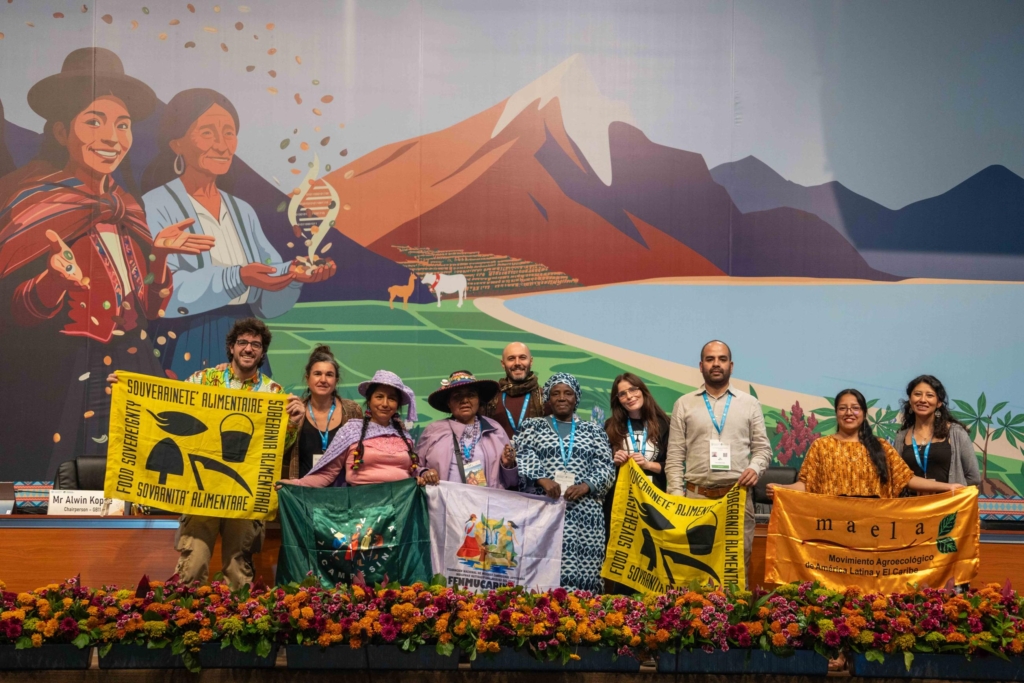
December 1, 2025
After a week of tireless negotiations in Lima, the Governing Body of the International Treaty on Plant Genetic Resources for Food and Agriculture (ITPGRFA) failed to achieve consensus on a compromise proposal for enhancing its Multilateral System (MLS) put forward by the Chair, Alwin Kopse in a last-minute attempt to break the deadlock. His extreme try was rejected by the plenary, where basically all countries from Africa, GRULAC and Asia (except Japan and South Korea) refused to approve a package they did not have time to properly review and discuss. After twelve years of discussion with no progress on this particular topic, such a miserable outcome was expected, and having restricted the participation in the key moment did not help the Chair to get over the line.
Lack of information on the process, documents circulated only in English, contact groups without interpretation often obliged negotiators to deal with very sensitive matters in complete discomfort.
We spent around 20 hours in contact groups on Farmers’ Rights, fighting hard to have our voice heard, to no avail. In plenary, we made a strong demand to ensure that lack of progress on finalising the resolution should not shut farmers out through a closed-door, Friends of the Chair process whereby only Contracting Parties are invited to negotiate our rights away from us.
While able to participate in the contact group on Farmers Rights, the wins we’d fought for during the intersessional work in the Ad Hoc Technical Expert Group on Farmers’ Rights (AHTEG) were swiftly shot down by Japan and North America, who made ruthless attempts to diminish our efforts to examine legal measures for Contracting Parties to implement Farmers’ Rights at the national level. Instead of focusing on finalising the draft resolution to move forward with implementation of Farmers’ Rights, tactics were deployed to restrict use of legal measures, refusing to move forward until the scope of future work undertaken by the AHTEG will not include such measures. In addition, Japan insisted that Farmers’ Rights should not impinge on countries’ obligations under UPOV, and that the AHTEG’s mandate should include work on Intellectual Property Rights. Rejected by the IPC, Europe, Africa and Latin America – where many countries do not subscribe to UPOV – and backed only by a representative of the private seed sector, the IPC staged a walk out, as we refuse to be complicit in the desecration of Farmers’ Rights, which looks to become a facade for upholding restrictive seed laws and Breeders’ Rights.
From here, a Friends of the Chair process was established and we were left with a woeful resolution that has left us questioning whether or not the AHTEG will be a safe space for farmers to participate in over the next intersessional period.
The IPC was also kept in the dark and excluded, along with other observers from the negotiations on the Multilateral System after the first two days.
The Chair’s proposal was crafted on the last day of negotiations, when it became evident that no common landing ground would be found on the package of measures for enhancing the Multilateral System of the Treaty. The text under discussion at the eleventh session of the ITPGRFA Governing Body was meant to tackle some interconnected issues, grouped in the so-called “three hotspots”: Digital Sequence Information (DSI), payment structures and rates, expansion of the Annex I to the Treaty, with the aim of increasing the number of crops available for facilitated access in the Multilateral System.
One of the ITPGRFA core pillars, the MLS is a network of national and international genebanks following common rules for giving access to their ex situ collections of Plant Genetic Resources for Food and Agriculture (PGRFA), counting around 2,6 million of samples of 64 species of crops listed in Annex I of the Treaty. Users of these PGRFA can access the MLS by signing a binding contract, called Standard Material Transfer Agreement. By doing so, they commit not to restrict access to that PGRFA, its genetic parts and components through Intellectual Property Rights. They also agree to share the benefits arising from the use of these resources after many years, when they commercialise a product (like a new plant variety or a genetic modified organism) incorporating them. The money should be paid to a Benefit Sharing Fund (BSF), from which it is supposed to flow back, through a project-based mechanism to those countries and farmers communities who contributed the most to world’s agrobiodiversity.
Lack of transparency and accountability in the Multilateral System, which basically doesn’t have a mechanism for tracking and tracing the exchange of PGRFA beyond the first access, thereby depriving farmers, who are the main suppliers, of these resources, is the reason why the Benefit Sharing Fund is almost empty after 16 years. This is not the major issue for peasant organisations participating in the negotiations under the International Planning Committee for Food Sovereignty (IPC). They fight for their rights to save, exchange and sell their farm-saved seed, as defined under Article 9 of the Treaty. The major issue for the IPC is the growing use and patenting of Digital Sequence Information (DSI) available on open access databases and corresponding to genetic parts or components of PGRFA taken from the MLS as well as from traditional peasant seeds. This practice is already restricting facilitated access to its collections, farmers’ and traditional breeders’ rights to continue using and selling seeds they have selected and conserved, and violating the Treaty provisions.
While North America, Europe and developed countries of Asia try to legalize biopiracy by talking about DSI as it was just a product of research out of the scope of the ITPGRFA, peasants organisations and the rest of the world think it should be treated as a component of a genetic resources, although in digital form. This way, no patents on DSI could restrict the facilitated access to the corresponding physical genetic resources.
This deep disagreement is aggravated by different views on the reform of the payment structures and the expanded Annex I. Countries from the Global South would like to increase the predictability of contributions in the Benefit Sharing Fund as a precondition for including more PGRFA in the amended list of PGRFA available in the MLS. Richer countries try to sabotage this plan to get the most from for their multinational corporations without holding them accountable for the use of the seeds.
Finally, the Governing Body did not wish to reiterate that the ITPGRFA is the implementation of the Convention on Biological Diversity and reaffirm its competences against CBD initiative to circumvent the benefit-sharing obligations and the prohibition on patenting PGRFA from the Multilateral System, including the DSI they contain, through a voluntary (and therefore ineffective) benefit-sharing scheme, and by removing the prior consent that allows Indigenous Peoples and peasant communities to oppose these patents. Failure to explicitly recognise the exclusive competence of the ITPGRFA over PGRFA in the MLS would effectively spell the end of the rights of farmers and traditional breeders.
This is the context in which the last-minute proposal (Text / Annex) from the Governing Body Chair landed on the giant screens of the Lima Convention Center. The request was to park all this discussions and approve a revised SMTA, with the view to be adopted at the next meeting of the Governing Body in 2027. But it was a bad move, as GRULAC, Africa and developing countries of Asia demanded to solve the outstanding policy issues before supporting the approval of a new legally binding contract without having the time to discuss it. After some counterproposals got opposed by other countries, the Chair had to acknowledge the flop. This failure, although saves the Treaty from getting closer to become a legal tool for biopiracy, keeps it largely unimplemented after 25 years from its approval.
Therefore, the IPC calls on countries that really want to work on implementation based on the best principles of this International Treaty, to work with peasants organisations at the national level and protect, promote and realise their rights to seeds, stopping biopiracy from the seed industry.