

November 25, 2025
For the eleventh time since its ratification, the Governing Body of the International Treaty on Plant Genetic Resources for Food and Agriculture (ITPGRFA, or Plant Treaty) is meeting to assess its functioning and state of implementation.
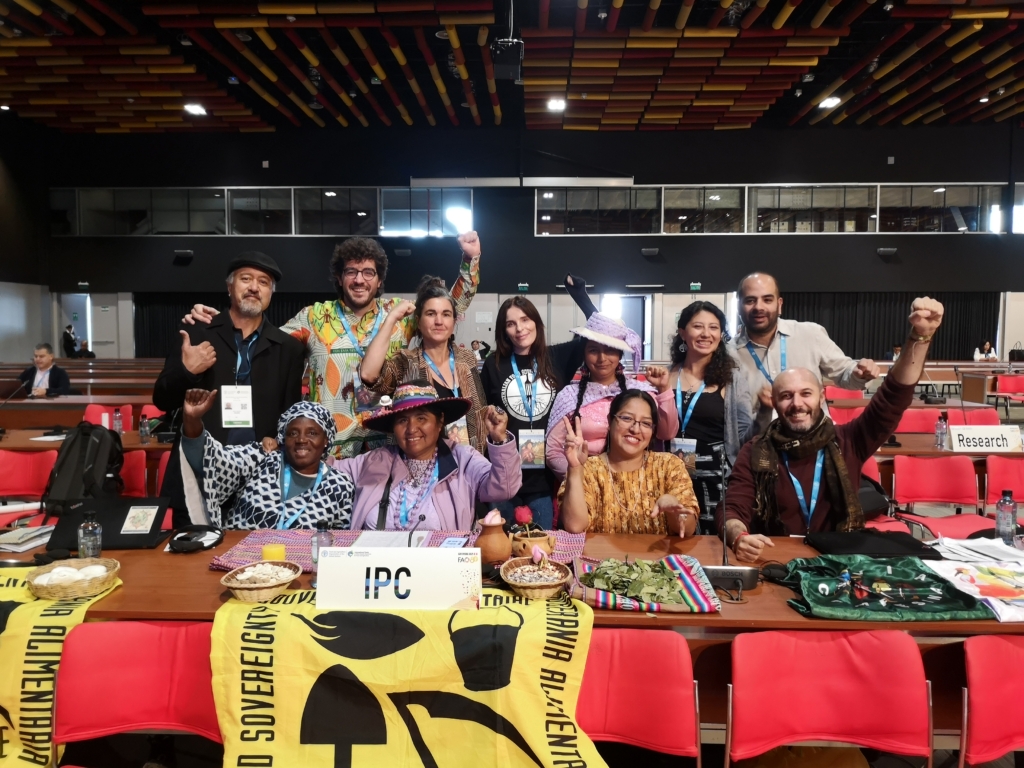
The meeting, which opened in Lima on 24 November, is attended by delegates from 155 countries, plus observers from farmers’ organisations, NGOs, academia and the seed industry. Farmers’ and Indigenous Peoples’ organisations, represented by the International Planning Committee for Food Sovereignty (IPC), are participating with a delegation of 14 people from Peru, Guatemala, Mali, France, Australia, New Zealand, Mexico and Italy.
At stake are issues of vital importance for the future of the Treaty and its very raison d’être. This international agreement, approved in 2001, was created as an attempt to ensure easy access to seeds of 64 plant species of particular interest for food security, contained in the genebanks of the Contracting Parties.
These collections of Plant Genetic Resources for Food and Agriculture (PGRFA), which now number around 2,6 million samples, were originally conserved, reproduced and supplied by (or collected on) farmers around the world. They represent an enormous source of agricultural biodiversity, whose genetic code contains the traditional knowledge of those who cultivated them, adapting them to the territories, climatic and biotic stresses.
Facilitated access to this network of genebanks and research institutes, known as the Multilateral System (MLS), requires the signing of a contract (Standard Material Transfer Agreement – SMTA). Public or industry researchers who intend to use these resources to develop new varieties are obliged not to patent the genetic resources obtained from the Multilateral System, their parts and components. Facilitated access to these resources must always be guaranteed, while Intellectual Property Rights would restrict it, violating Article 12.3d of the Treaty.
However, seeds taken from the Multilateral System may contribute to the development of privatised commercial varieties which do not restrict access to the original PGRFA. In this case, companies using genetic resources from this “common” space must return a share of their profits to a Benefit-Sharing Fund (BSF) managed by the Treaty’s Governing Body. The funds raised should be used to finance local agrobiodiversity conservation projects.
However, this architecture has never worked. While access has been widely used, with 7 million transfers of genetic resources recorded as of 2025, there are no corresponding contributions. Due to numerous legal loopholes and different interpretations of the Treaty, only 800,000 USD has been paid by companies that have accessed the Multilateral System since 2009. Another 36 million has been provided as donations from some governments and other institutions. The beneficiaries of the projects are generally genebanks and NGOs, while the funds almost never reach farmers’ organisations directly, for whom it is very difficult to apply for projects.
The lack of traceability in the transfer of seeds that can occur after the first access to the Multilateral System is one of the problems that makes it impossible to understand who should pay for the use of the germplasm collected and when. Even worse, it is not possible to verify who is obtaining patents on genetic traits of MLS samples that would restrict access to the genetic resources that contain them, in violation of the Treaty.
With the growing application of so-called artificial “intelligence” to biotechnological operations, the digitisation of DNA contained in life forms has become a common practice, and seeds from the Multilateral System make no exception. Researchers who use them for their work publish the digital DNA sequences in their studies and upload them to open access databases on the Internet, without any obligation to indicate their origin. Millions of digital DNA sequences, including those corresponding to physical resources managed under the rules of the Treaty, can thus be downloaded and used to identify traits of commercial interest, creating modified patented seeds. The reluctance of North American countries, together with the European Union, Australia, Japan and Korea, has for years blocked the recognition of digital sequence information (DSI) as a component of genetic resources, for which the Treaty prohibits patenting when included in the Multilateral System.
This huge legal loophole is allowing companies to circumvent the rules of the ITPGRFA and patent its genetic resources based on their digital counterpart. Evidence of this can be found in data published by the network of international agriculture research centres (CGIAR).
These patents are fuelling the exponential acceleration of seed market concentration in the hands of the world’s leading companies like Bayer-Monsanto, BASF, Syngenta, and Corteva.
The Governing Body of the Treaty is therefore called upon to resolve this incompatibility between digital biopiracy, which is growing as DSI are uploaded to open access databases, and international law. The work carried out by an intersessional group of government delegates, in which the IPC participated as stakeholder, has now resulted in a package of measures that should improve the functioning of the Multilateral System. However, these are weak and insufficient, and are being proposed alongside a request from rich countries to include all genetic resources for food and agriculture in the reformed MLS, going well beyond the list of 64 species currently covered.
According to these governments, increasing the “endowment” of the MLS would encourage companies to access it more frequently and pay the fee due when commercialising varieties that incorporate that germplasm. However, without a clear prohibition (expressed in the SMTA and reflected in national legislation) on patenting the corresponding PGRFA (which those same countries oppose), this would lead to massive expropriation and privatisation of agrobiodiversity by the private sector, circumventing Article 12.3d.
Furthermore, Farmers’ Rights to save, exchange and sell their farm-saved seeds, recognised by the Treaty itself in Article 9 and already violated in many countries, would be irreparably compromised once genetic traits contained not only in the MLS, but also in their “relatives” grown in the fields, suddenly fall under the scope of a patent obtained by a company on the corresponding digital sequence information.
Therefore, the IPC is in Lima with the aim of fighting against the enlargement of the MLS to all genetic resources for food and agriculture contained in genebanks collections, calling for patents on the DSI contained in these resources to be banned at national and international level first. Only then, when the MLS has become a safe place, will farmers’ organisations be keen to discuss its expansion.
Watch all IPC interventions