

September 21, 2026
Photo Credits: FAO/Valerio Muscella
September 2026 marked a growing wave of connections, strategies, unity and solidarity for small-scale fishers, fish workers, shell collectors, fisherwomen, and Indigenous Peoples organised within the International Planning Committee for Food Sovereignty.
Building unity ahead of COFI37
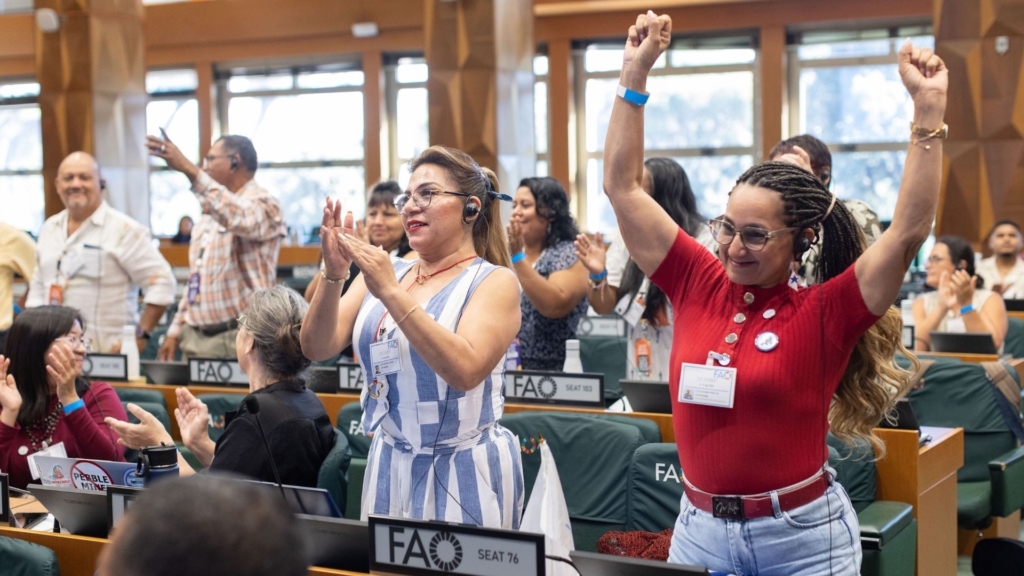
The FAO Committee on Fisheries (COFI37), where the future of our waters, territories and ways of life was put once again on the negotiating table, was a key moment of convergence in unity and solidarity for Fisher and Indigenous Peoples from all over the world. A delegation of more than 30 members from World Forum of Fisher Peoples (WFFP), the World Forum of Fish Harvesters and Fish Workers (WFF), the International Indian Treaty Council (IITC), and La Via Campesina (LVC) gathered for three days to reconnect, engage in political discussions and prepare for the 3rd Small-Scale Fisheries Summit and COFI.
The SSF Summit convened ahead of COFI 37, bringing together WFFP, WFF, IITC, LVC, alongside small-scale fisheries organisations from every continent, together with researchers, academia, NGOs and Governments.
Ten years of the SSF Guidelines: from commitments to implementation
Ten years after their adoption, the Voluntary Guidelines for Securing Sustainable Small-Scale Fisheries remain one key international instrument that centres the human rights, dignity, and self-determination of our fisher and Indigenous Peoples. The SSF Summit was a crucial forum, before COFI37, to create a space of global governance for the implementation of the SSF Guidelines through the reactivation of the Global Strategic Framework for the Implementation of the SSF Guidelines. Members from different regional and international organisations met with academics, researchers, NGOs and Governments to take stock of the SSF Guidelines implementation worldwide, identifying best practices and rebuilding an informal space for dialogue and exchanges.
We asked FAO and Member States for concrete support at the national, regional and global level, leveraging the Global Strategic Framework for the SSF Guidelines Implementation and its components. We called upon new potential allies to rebuild the global governance of the SSF Guidelines Implementation.
Challenging the language of “blue growth”
In COFI, we remarked once again that the language of “blue growth” and “sustainable intensification” obscures what these terms actually mean in the lived experiences of our comrades: the industrialisation and privatisation of our land and aquatic commons. This is why bringing our Global Campaign Against Industrial Aquaculture has been a crucial part of the process, to give voice to the struggles of our communities, who are seeing everyday land and coastal areas grabbed, mangroves razed for shrimp ponds, coastal waters poisoned by effluent, small-scale fishers and Indigenous Peoples dispossessed of access while corporate aquaculture is subsidised and celebrated as a sustainable solution in response to population growth and food security.
Defending our waters, territories and aquatic commons
Our solution and our political horizon are aquatic food systems governed by small-scale fisheries and Indigenous Peoples, who depend on them, rooted in agroecological principles, ancestral and Indigenous Peoples’ knowledge, and Food Sovereignty rather than extractive value chains built for export markets and distant shareholders.
Our task is to build a policy change, a narrative shift that can respond to our communities’ struggles. We came as protagonists of our own destiny, bearers of knowledge accumulated over generations, defenders of the last commons and we will continue to fight for our Fisher and Indigenous Peoples’ rights! A luta continua!!