

September 7, 2026
Photo Credits: FAO/Valerio Muscella
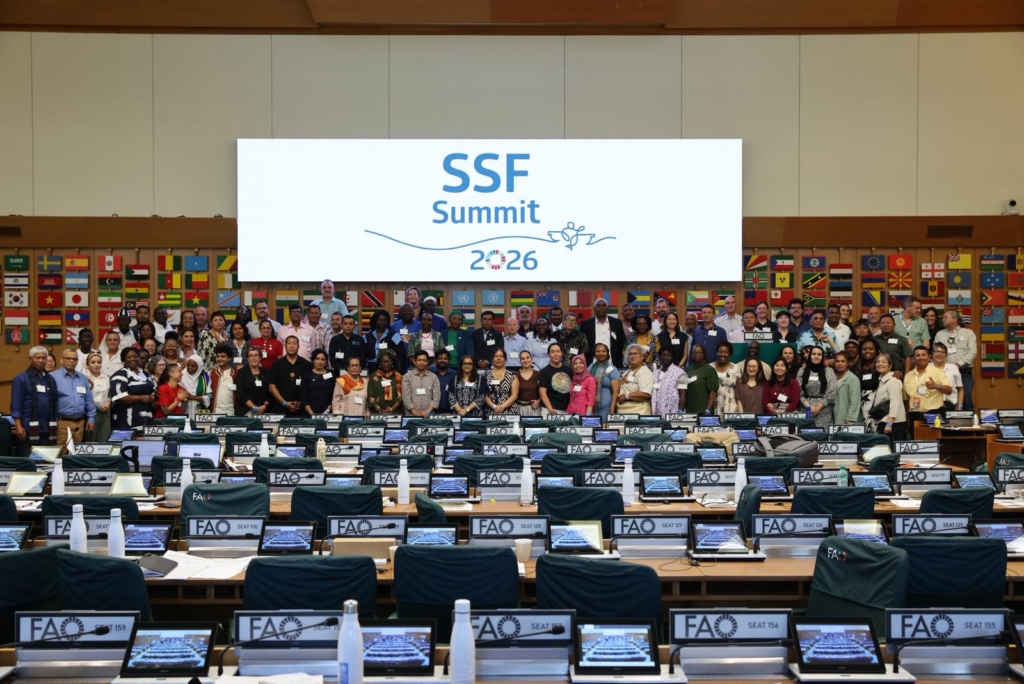
After three days of discussion, exchange and collective strategising, the third Small-Scale Fisheries Summit (SSF Summit 2026) closed today at FAO Headquarters in Rome. The Summit brought together hundreds from all the world’s regions, including small-scale fishers, fish workers, fisher women, Indigenous Peoples, NGOs, researchers and government representatives, to strengthen collective action and advance the implementation of the Voluntary Guidelines for Securing Sustainable Small-Scale Fisheries (SSF Guidelines).
The Summit took place immediately ahead of the 37th Session of the FAO Committee on Fisheries (COFI37), which begins today. The Committee brings together governments to discuss global fisheries and aquaculture policies, with small-scale fisheries among the issues on its agenda.
For fisher movements, the transition from the Summit to COFI is a crucial moment. The representatives gathered in Rome will continue to bring their experiences and demands into the discussions, pushing governments and FAO to move from international commitments to concrete action at national and local levels.
Implementing the SSF Guidelines
A central focus of the Summit was the implementation of the SSF Guidelines, adopted by COFI in 2014 following a global, bottom-up consultation involving more than 4,000 fishers, fish workers and other actors from over 120 countries. The Guidelines are the result of the work of social movement representatives and represent a tool to bring together human rights and the collective rights of fishing communities
However, more than a decade after their adoption, and despite the creation in 2016 of a dedicated partnership mechanism, the Small-Scale Fisheries Global Strategic Framework (SSF-GSF), the Guidelines remain largely unfulfilled and fisher movements continue to face a major gap between commitments and implementation.
Exchanges of national and regional experiences highlighted the multiple threats affecting the survival of small-scale fisheries. Extractive projects in the oil and gas sector, large infrastructure projects, overtourism, industrial fishing and aquaculture are increasingly shrinking the small-scal fishers’ living space.
Yet, the communities are fighting back: movements are organising, resisting and defending their territories and livelihoods, including suing those governments that, despite adopting the Guidelines, continue to allow violations to happen.
Fishers movements called on FAO to support their work within respective countries and increase pressure on governments, since commitments at the international level rarely translate into binding national policies. Brazil, Tanzania, Venezuela and Senegal made commitments to advance the SSF Guidelines: an important step forward. Yet, on this last day we were indignant at the FAO Director-General shamefully presenting industrial aquaculture as sustainable and as the future of aquatic food systems, while criticising small-scale fisheries as underdeveloped and unsustainable; but we were able to respond, and to gather support from non-IPC families, governments, researchers and academia, who also brought forward their own statements in solidarity.
Revitalising the SSF-GSF
Another key outcome was the commitment to revitalise the Small-Scale Fisheries Global Strategic Framework (SSF-GSF), established in 2016 to support the implementation of the SSF Guidelines.
Despite its potential, the framework has never came into function. Therefore, small-scale fisher movements committed to the revitalisation and expansion of the mechanism through its main components: The Advisory Group, the Regional Advisory Groups, the Knowledge Sharing Platform – an informal space for actors such as NGOs, academia, research institutes, regional organizations to support fishers movements – and finally the Friends of the Guidelines, Member Countries of the FAO Committee of Fisheries (COFI) entering on a voluntary basis an providing programmatic advice and guidance.
Knowledge, gender and youth
The Summit also highlighted the need to rethink how knowledge and research are produced. Fisher organisations highlighted that inside academic institutions, research priorities should be co-designed with fishing communities, and findings are shared and discussed with them before publication.
Women and youth were also recognised as central to the future of small-scale fisheries, with participants calling for their meaningful participation, leadership and greater visibility within fishing organisations and policy processes.
From the SSF Summit to COFI37
For the first time, the SSF Summit also included a Ministerial Session, bringing together government representatives in direct dialogue with small-scale fishing movements. The session underscored the growing political recognition of small-scale fisheries and the importance of strengthening dialogue between governments and rights-holders. But recognition must be followed by action.
As governments begin their discussions at COFI37, the message from the SSF Summit is clear: it’s time to shift from commitment to action. Small-scale fishers and indigenous people are pushing for change, and recognising their demands and agency is essential to achieve Food Sovereignty.