

May 27, 2026
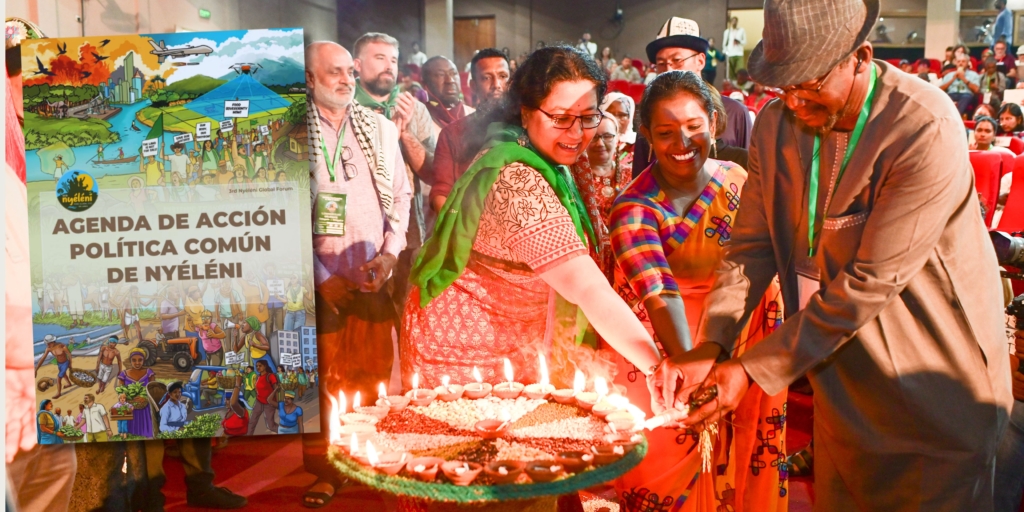
After the 3rd Nyéléni Global Forum in Sri Lanka in September 2025, which brought together over 500 representatives of social movements and grassroots organizations from across the world, the Common Political Action Agenda (CPAA) that will guide the movement actions in the years to come is finally out.
The CPAA is a comprehensive roadmap organized around six interrelated axes of struggle: constructing people’s democracy and rights; building people’s economies based on solidarity and feminism; advancing food sovereignty and agroecology; securing land, water, and territories through popular agrarian reform; achieving comprehensive health for all; and ensuring climate justice through a feminist just energy transition
Beyond these goals, the CPAA details a strategy for collective action centered on joint mobilization, internationalist solidarity, and transformative policy advocacy. It commits movements to an ambitious process of political formation and popular communication to reclaim narratives and strengthen grassroots power from the bottom up.
The CPAA is intended as a shared political reference point for collective struggle. Its implementation depends on the continued engagement of movements and allies to translate its priorities into coordinated action, campaigns, and resistance across territories and regions. This is the tool that we built, as peoples and social movements from all across the globe, to forge the path for the systemic transformation that we want for a better world now and forever!
Download the CPAA (Arabe: soon)
Download the CPAA (Sinhala: soon)
WHY DOES THIS MATTER?
The world faces the capitalistic, imperialistic, colonialistic, patriarchal, and racist system. A multiple systemic and interrelated crisis rooted in these interlocked forms of oppression that put profits over life, transforming the commons into commodities, and concentrating wealth in the hands of a few while condemning the majority to deprivation. Fascism and authoritarianism are on the rise, states increasingly oppress rather than protect, and activists, journalists, and human rights defenders face persecution with impunity, while bold commitments for change remain on paper without implementation. At the heart of this crisis lies a profit-driven agro-industrial food system that undermines food sovereignty and destroys both the environment and public health, as corporate influence captures multilateral governance spaces, weakens human rights frameworks, and promotes false solutions, such as green capitalism, carbon markets, and climate-smart agriculture, that serve financial actors rather than people or the planet. Meanwhile, digital colonialism emerges as a new frontier, as the datafication of agriculture, health, and territories converts life itself into a continuous source of profit, further concentrating power in the hands of a few corporations. It is in direct response to these converging crises that the 3rd Nyéléni Global Forum was convened: to mobilize movements, overcome fragmentation, and advance the transformative vision of food sovereignty as an emancipatory paradigm for systemic transformation.
The Nyéléni Common Political Action Agenda (CPAA) is a collective political document produced at the 3rd Nyéléni Global Forum, bringing together a broad and diverse coalition of political subjects from different struggles from around the world. Structured in five sections, the document opens by defining who these political subjects are and the shared values that unite them, including food sovereignty, agroecology, popular feminism, and internationalist solidarity. The second section offers a deep diagnosis of the systemic crises that drive collective action to dismantle its basis. The third section sets out what the movements seek to achieve, organized around six interrelated axes:
- construct and defend people’s democracy and rights, peace and internationalist solidarity;
- build people’s economies;
- advancing food sovereignty and agroecology;
- securing land, water, and territories through agrarian reform;
- achieving health for all;
- and achieving climate justice alongside a feminist and just energy transition.
The fourth section details how this agenda will be implemented through five strategies:
- mobilization and internationalist solidarity;
- advocacy and policies;
- movement building;
- political formation and people’s knowledge production;
- and popular communication.
All these are grounded in an intersectional and decolonial approach.
Finally, the fifth section presents a collective pledge, committing all participating organizations to translate this agenda into contextualized regional and local action plans, guided by an ongoing coordination and evaluation mechanism.
What is the Nyéléni Process?
Nyéléni is a living process of convergence among the world’s social and popular movements. It is a collective construction rooted in the legacies of struggles for food sovereignty, agroecology, and liberation that have kept the fight against oppression alive for decades. Its participants honor the legacy of Nyéléni, a Malian peasant woman who symbolizes the central role of women in sustaining food systems, territories, and collective life. Building on the Nyéléni 2007 Forum for Food Sovereignty and the Nyéléni 2015 International Forum for Agroecology, this 3rd Forum represented a necessary advance: a broadening of alliances among peoples oppressed by the current system of domination, grounded in shared values of food sovereignty, popular feminism, people’s self-determination, and internationalist solidarity. It sought to build unity for action from diversity through dialogue, the exchange of knowledge, and collective grassroots organizing. The convergence of these political forces in the 3rd Nyéléni Global Forum produced a concrete and historic outcome: a Common Political Action Agenda (CPAA) for achieving people’s power and advancing systemic transformation.
Contact for more information: press@foodsovereignty.org